

Operations Council recently held a webcast panel discussion on the 2025 State of Operations Talent Study Results.
Our expert panelist included Matt Barnes. Matt is Managing Partner at Workfast Consulting, an operations consulting firm focused on helping people connect strategy with execution through individual coaching, developing culture, and applying proven continuous improvement practices. Matt’s 20 years of experience includes Vice President of Operations at Peak Technologies (a supply chain solutions provider), Director of Operations at TransMontaigne Partners (an energy supply chain services company) and in program management and project management roles across various industries. He began his career as a Commissioned Officer in the United States Navy and had the opportunity to serve and lead in overseas contingency environments and in the White House Military Office.
During this discussion, Matt and Neil discussed several key predictions for operations talent in 2025. If you are interested in learning more, view the full webinar archive video here. Following are some of the study and panel highlights.
What are Your Organization’s Hiring Plans for Operations Staff in the next 12 months?

Neil: In 2025, 51% maintaining 43% increasing 6% versus 2024, 48, 47 and 5 and 2023, 48, 46 and 6. So Matt, very consistent year over year hiring, maybe a slight downward trend of hiring increases. What is your perspective on this?
Matt: I think I’m a little bit surprised at how consistent it is, be honest with you. I figured there’d be more of a decrease given a lot of volatility that’s going on, though the economy seems to continue to go strong. It’s interesting to hear workforce dynamics and whether people are delaying retirement or not. They may have something to do with it that we may see people stay in the workforce a little bit longer. And I think ultimately it gets down to what industry are you in and what’s going on in that industry. So high level, I’m frankly a little bit surprised at how consistent it’s been for the last few years, given where we were in 2023, still relatively close to coming out of COVID. So, a lot of the way I think, and maybe a lot of people now think about things, it’s kind of like where it was pre-COVID, where it was post-COVID, and now we’re about five years from there. So, are we kind of normalizing in some ways?
What will be Your Company Policy regarding Hybrid, Onsite and Remote Work Models in the next 12 months?

Neil: In 2025, 46% plan a hybrid combination of onsite and remote options, along with a significant 38% expecting to be fully onsite, and only 16% fully remote. This represents a significant shift to onsite, more than double than each of the last two years. So Matt, what are you seeing with clients regarding hybrid on-site and remote work models?
Matt: Frankly, this comes up all the time still. Most of my clients are hybrid for folks that can be hybrid. Of course, if you have a frontline job in, a warehouse or a manufacturing operation, you must be there on site. I’ve seen companies go one way and the reverse course. One of my clients wanted to make people come into office and they found that it wasn’t as productive as they thought it would be. And in fact, it didn’t really impact anyone other than the accounting team. And they were very unhappy, therefore, it’s interesting. You must evaluate what the real impact is, why you’re doing it, and what is the policy you’re trying to promote, and then measure the outcomes like anything. But yeah, I think that hybrid is prevalent in most organizations I work with, and that very few that I work with have gone to full remote.
What were Average Annual Pay Increases by Staff Level in the last 12 months?
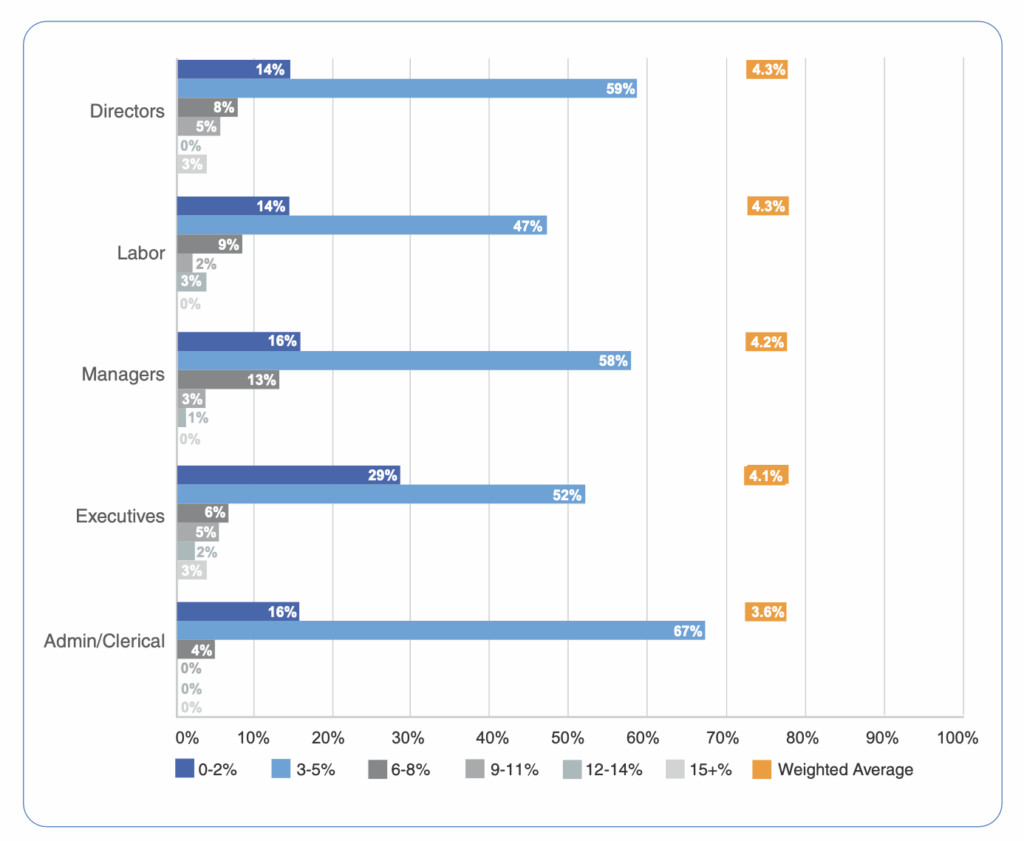
Neil: Operations survey respondents reported moderate annual pay increases in the last 12 month across all employee types, and similar increases to national averages. Director level and labor functions were tied at 4.3% weighted average increases, followed by managers (4.2%), and executives (4.1%). Administrative and clerical weighted average increases were lowest of all types at 3.6%. Matt, are these percentages in line with what you have experienced in the market?
Matt: Yeah, absolutely. This is close to what I’ve seen and heard from customers. I think it aligns with what we’ve seen in terms of inflation, maybe a little below inflation. But I think this is a little more than we’ve been used to in the past in terms of the number. So, I mean, yeah, it’s good. I’ve heard a couple of companies recently also that we’re working with are taking some benefits out at beginning of the year because they just weren’t sure how the year was going to go. Then they’re adding those benefits back in to just 401k match percentage and that sort of thing. So, I think that’s a positive sign.
Which Operations Skills are the most Challenging to Recruit for in Your Organization?
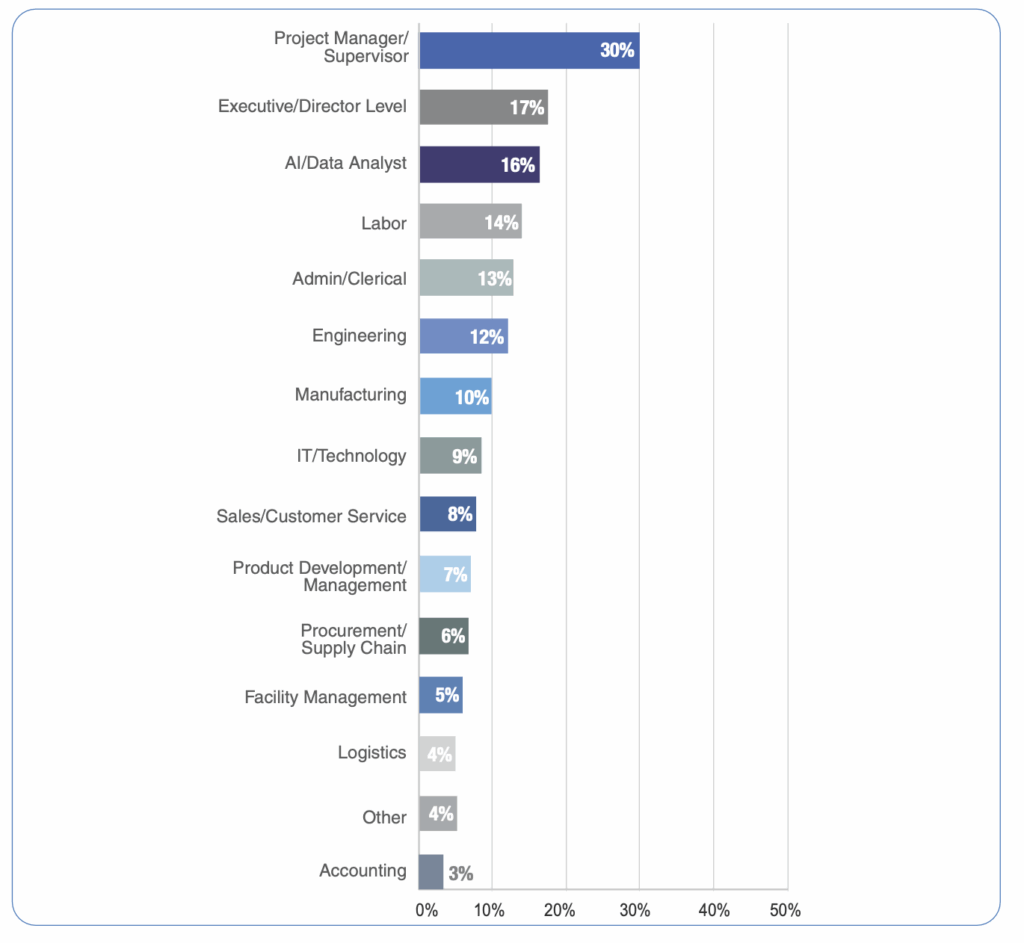
Neil: In 2025, project managers rank as the most challenging function to recruit for 30%, followed by a 2nd tier of rankings that includes executives/directors (17%), AI/data analysts (16%), labor (14%), administrative/clerical (12%), engineering (12%), and a 3rd tier including manufacturing (10%), IT/technology (9%), sales/customer service (8%), and more. Matt, Do you think that it’s shifted to an employer’s market? And secondly, what functions do your clients see as the most challenging?
Matt: Yeah, it does feel like it’s more of an employer’s market and I think some of that has to do with the, you know, uncertainty people were filling around the economy at the beginning of this year. We’ll see if that changes back now that things seem to be a little bit more steady state. Maybe there’s a little bit more confidence. You know, the project manager at Clash Supervisor is interesting. I think that maybe that’s a function of not as many project managers changing jobs or more experienced people leaving the workforce. I think in general, they’re highly valued if they’re good. And they are well compensated and well looked after. You may see just less switching there. AI data analysis is kind of interesting. I guess that’s a new thing. So maybe that’s why it’s challenging. But you’re to see a lot more people entering the workforce that have that type of skill set. There are a lot of colleges that are starting to train for that. So that’s interesting.
Does Your Organization Contract or Outsource any Operations Functions?

Neil: In 2025, a majority 54% of respondents use consultants, contractors or outsource limited operations functions, compared to 33% that do not contract or outsource any operations functions, and 12% contract/outsource or many operations functions. Matt, any surprises here?
Matt: Yeah, not surprising. Selfishly, I’d like to see consulting be higher in the ranking, but this generally lines up with what you would think it would.
To view the complete webcast panel discussion, click here.
To download the full study report, click here.

0 Comments